Search This Blog

Friday, 15 May 2015

BUDDHIST ICONOGRAPHY IN BIHAR A.D. 600-1200 isbn 9789385161025


by Jayadeva Mishra

2015, 22 cm., pp. 299, isbn 9789385161025, Rs. 1295 / US$ 21.28

About the book :

In the present work Dr. Jayadeva Mishra has utilized the archaeological and literacy sources material bearing on the topic. He has made on the spot study at several sites in Bihar, which have yielded Buddhist figures in stone, bronzed and clay. Although, Buddhist art had grown in the area of Bihar before C. 600 A.D., it was during the period between 600 and 1200 AD. that its all round development took place at sites like Nalanda, Kurkihara, Bodh-Gaya, Vikramsila, Tirabhukti, (Mithila and Vaishali) and several sites of Bihar.

In this connection Dr. Mishra has made a meticulous study on the origin and development of Buddhist pantheon of Bihar and has also dealt with that of Nepal where ever it is found relevant. He has also dealt very clearly about the emanations of various Dhyani Buddha and Bodhisattvas which is a very interesting subject to deal with the scholar has well explained the subject based on the various traditional beliefs and ideas. Dr. Mishra has dealt with the evolution of Buddhist iconography in Bihar in a coherent way. He has clearly indicated the role of Mahayana and Tantrayana in the formation of the Post-Gupta Buddhist Pantheon. The nature of the syncretic and other images has also been clearly defined. It is for the first time that a detailed and up to dated study of the subject has been presented I here. The conclusion arrived at by Dr. Mishra are sound and indicate its acumen. The documentation is to the mark at high standard. Dr. Jayadeva Mishra has put in about three decades of teaching experience in the E Post Graduate Department of Ancient Indian History & Archaeolo

Thursday, 7 May 2015

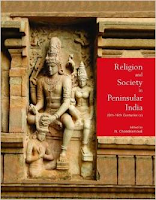
Religion and Society in Peninsular India : 6th-16th Centuries CE


 Religion and Society in Peninsular India
6th-16th Centuries CE
N. Chandramouli (Ed.)
2015, Hardcover, pp. pp. xxiv+230, ills. 56
ISBN: 9788173055379 / 8173055378
Price : US$ 37.50 or Rs. 2250
About the Book : 
The present volume is a collection of 18 research papers on various dimensions of religion and society in peninsular India during 6th-17th centuries written by distinguished and well-known scholars in their respective areas of research. The first paper deals with the general issues of historical and archaeological research followed by one on the making of religious traditions in peninsular India. Six papers trace the religious developments in the Karnataka region, focusing on the growth of Vaishnavism, sacred geography in the songs of Purandaradasa, the cult of Kartikeya, iconography of Narasimha and Mahishasuramardani and temple induced urbanism of Hampi. Three papers focus on Jainism, Saivism and maritime history of Tamil Nadu. Three papers are on the Kerala region dealing with topics like Vaishnava Bhakti, Saptamatrika cult and growth of Padmanabhaswamy and Guruvayur Krishna temples during 10th-16th centuries CE. One paper deals with the construction of social ranking in medieval Andhra Pradesh while three papers are on Sufism in the Deccan region. The volume will serve as a standard reference work for the scholars and students of the history of peninsular India. 

Monday, 4 May 2015

Nalanda : Situating the Great Monastery by Frederick M Asher isbn 9789383243075

 Nalanda : Situating the Great Monastery 

by Frederick M. Asher

 http://easternbookcorporation.com/moreinfo.php?txt_searchstring=18478

                   2015,  isbn 9789383243075 Hardcover, 32 cm., pp. 140, ills., US$ 42  or Rs. 2520


About the book : 

From its inception, circa the 5th century ce, mahavihara or great monastery of Nalanda attracted monks from China, Korea and Tibet perhaps other distant places. Their written accounts, along with the records from the site provide considerable data, critically studied and contextualized in this volume. This book sees the ancient mahavihara as a dynamic and ever-evolving complex rather than an institution that was static during the millennium it was active as a Buddhist monastery. The site was much larger than the present excavated area, a notion also suggested recently by remote sensing. The volume raises questions that help visualize a living, vital Nalanda that was part of a dynamic group of monasteries in close proximity in the Magadha region. 

Contents : 1. Nalanda's Patrons, 2. Nalanda According to Xuanzang, Cunningham and Other Writers, 3. Nalanda as Excavated Ruins, 4. Nalanda's Sculptures and Paintings, 5. Nalanda Today, 6. Looking Back, Looking Ahead.

Buy online at www.easternbookcorporation.com

Sunday, 15 March 2015

Shipwrecks around the World by Sila Tripati

Shipwrecks Around the World
Revelations of the Past
Sila Tripati (Editor)

2015, 26 cm., Hardcover, pp. xx+827, figs, mapsisbn 9788192624440, Price US$ 74.07 / Rs. 4000
To buy online visit www.easternbookcorporation.com

About the Book :

In recent years more people and institutes have realised the importance of our maritime past and the need to save the remains from the ravages of time and illegal activities through recently developed tools and scientific methods of maritime archaeology. The developed scientific techniques have helped to make maritime archaeological studies more systematic. And now it is possible for archaeologists to reconstruct in detail the daily lives onboard, commerce and technology from findings such as cargoes, personal belongings and ship remains. 'Shipwrecks around the World: Revelations of the past', covers the story of many shipwrecks from the 15th century onwards, from the Pacific to the Mediterranean, from the north Atlantic to south Atlantic, from Europe to Australia, each shipwreck encapsulating a moment in time and thus illuminating an entire era. The book contains 35 significant and scholarly articles written by specialists involved in the scientific survey of shipwrecks. In addition to papers on shipwrecks, there are papers on conservation of shipwreck finds, and UNESCO Field School on Underwater Cultural Heritage 2009-2011, Thailand, capacity building in the Asian and Pacific Region, and the 2001 UNESCO Convention on the Protection of the Underwater Cultural Heritage. The book contains illustrations of lost ships, drawings supported by original maps and a good number of both inland and underwater photographs of artefacts and antiquities that were recovered and documented in the course of exploration and excavation. Undoubtedly this book will fascinate, enhance the knowledge of researchers and scholars and provide them with an insight into shipwrecks. Shipwrecks around the World also provides one with a positive look at future sites and an exciting glimpse into deepwater shipwreck findings.

Contents :
1. The Pepper wreck as a case study for the Portuguese India route ships by Filipe Castro and Nuno Fonseca
2. The shipwrecks of the Baltic Sea - A unique maritime archaeological source material by Johan Rönnby
3. The Avondster (1659) wrecked twice in Galle: Historical-Archaeological research of an Anglo-Dutch East-Indiaman in Sri Lanka by Robert Parthesius
4. The wreck of the Quedagh Merchant: An Indian Merchantman captured by Captain William Kidd by Frederick H Hanselmann and Charles D Beeker
5. Triangular identities: In search of fragata Santo António de Tanna (Vasai/Goa 1680, Mombasa 1697) by Jean-Yves Blot
6. World history from the seabed: Rescuing a Portuguese shipwreck off the coast of Namibia by Shadreck Chirikure and Ashton Sinamai
7. Shipbuilding in India: Evidence from the Sydney Cove Shipwreck by Michael Nash
8. A survey for shipwrecks, submerged settlements and seafaring technology in Bahrain by Ralph K Pedersen
9. Archaeology of complete ships - on the potential of well-preserved wrecks of 17th century merchant fluyts in the Baltic Sea by Niklas Eriksson
10. The Tagbita Bay shipwreck: A late 19th century sailing ship by Bobby C Orillaneda
11. Exploration of iron, steel and steam shipwrecks in Australia by Michael McCarthy
12. Steamship technology through the ages - An overview by Malcolm Turner
13. Abandoned ships in Australia by Mark Staniforth and Nathan Richards
14. Some methodological aspects related to the study of historical shipwrecks, based on two decades of maritime archaeological research in Southern Africa by Bruno E J S Werz
15. Lead cooking braziers from a shipwreck off the Ashkelon coast, Israel by Ehud Galili and Baruch Rosen
16. The underwater archaeological survey conducted by the Greek Mission in Alexandria, Egypt (1998-2010) by Harry E Tzalas
17. The Department of Underwater Archaeological Research: An Administrative and Research Organisation concerned with underwater heritage of French territorial waters by Michel L’hour
18. Maritime Archaeology in Sri Lanka: Twenty five years old and a new beginning by Somasiri Devendra and Rasika Muthucumarana
19. Maritime archaeological explorations in Indonesian waters by Nia Naelul Hasanah Ridwan
20. Research in maritime archaeology in Portugal: A view of the past and present by Tiago Miguel Fraga, Cristóvão Fonseca, Inés Pinto Coelho, Jorge Freire, Patrìcia Carvalho and Andrè Teixeira
21. The potential of underwater archaeology in Kenya: A short communication by Caesar Bita
22. Maritime archaeology in New Zealand: Trials, tribulations and opportunities by Matthew Carter and Andy Dodd
23. Maritime and underwater cultural heritage of the United Republic of Tanzania: History, opportunities and future directions by Elgidius Ichumbaki B
24. Underwater Archaeology in Spain by Xavier Nieto
25. Memories of the sea by Patrick Lizè and Emmanuelle Lizè
26. Introduction to underwater excavation of cultural heritage in Korea by Whan-Suk Moon
27. An approach to Riverine Archaeology: The French example by Eric Rieth
28. Cupressus sempervirens (Cypress) as hull construction timber of sunken shipwrecks in the East Mediterranean by Nili Liphschitz
29. The conservation of waterlogged wood - An overview of developments by Ian Godfrey
30. The conservation of iron artefacts recovered from the marine environment by Jon Carpenter
31. Maritime Archaeology: The end of its subordinate role by Valerie Fenwick
32. The future of Maritime Archaeology: Geopolitics, Nationalism and Resource scarcity by Joe Flatman
33. UNESCO field school on underwater cultural heritage 2009-2011, Thailand capacity building in the Asian and Pacific region by Martijn Manders and Christopher J Underwood
34. The 2001 UNESCO Convention on the Protection of the Underwater Cultural Heritage by Arturo Rey da Silva
35. An overview of shipwreck explorations in Indian waters by Sila Tripati
Index 

Tuesday, 24 February 2015

Me Hijra, Me Laxmi : Autobiography of Laxminarayan Tripathi, a hijra isbn 9780199458264

Laxmi (Author)
P.G. Joshi & R. Raj Rao (Tr.)
2015, Paperback, pp. 264, isbn 9780199458264
Price Rs. 445.00, US$ 8.24
Buy this book online at www.easternbookcorporation.com

About the book :
 He was born a boy, but never felt like one. What was he then?
He felt attracted to boys. What did this make him?
He loved to dance. But why did others make fun of him?

Battling such emotional turmoil from a very young age, Laxminarayan Tripathi, born in a high-caste Brahman household, felt confused, trapped, and lonely. Slowly, he began wearing women's clothes. Over time, he became bold and assertive about his real sexual identity. Finally, he found his true self—she was Laxmi, a hijra.

From numerous love affairs to finding solace by dancing in Mumbai's bars; from being taunted as a homo to being the first Indian hijra to attend the World AIDS Conference in Toronto; from mental and physical abuse to finding a life of grace, dignity, and fame, this autobiography is an extraordinary journey of a hijra who fought against tremendous odds for the recognition of hijras and their rights.
 

Friday, 20 February 2015

Art, Icon and Architecture in South Asia


Essays in Honour of Dr. Devangana Desai (2 Vols.)
Anila Verghese & Anna L. Dallapiccola (Eds.)
2014, Hardcover, 31 cm., pp. 590, Illus. col. 54, b/w 274, 
Discounted Price : US$ 140.74 or Rs. 7600
To Buy this Book Online Click -  Indian Books Online

 About the Book :
These two volumes of papers by a galaxy of scholars are a tribute to the eminent art historian Dr. Devangana Desai, who has made an invaluable contribution in the field of Indian art, iconology and architecture. The thirty-seven thematic essays in Art, Icon and Architecture in South Asia include many by senior and very illustrious scholars as well as some by younger researchers who are now making their mark. 

Contents :
VOLUME I : Foreword — M.A. Dhaky, Preface and Acknowledgements, List of Illustrations Contributors; BUDDHIST MONUMENTS AND ICONS: 1. The Ashokan Stupa at Sopara — M.K. Dhavalikar, 2. Romancing the Silk Road: Gandharan Art from the Hirayama Collection, Japan — Pratapaditya Pal, 3. Kanganhalli (Sannati) and the Amaravati School: Some Observations — Elizabeth Rosen Stone, 4. Miracle of Shravasti Depicted in the Art of Kanheri and Kondivate — Suraj A. Pandit, ICONOGRAPHY, NARRATIVE SCULPTURE AND IMAGES : 5. Mathura’s ‘Personality’ and the Development of Narrative Art, — Doris Meth Srinivasan, 6. Varaheshvara from Bezeklik — Devendra Handa, 7. A Terracotta Vishnu from Rajghat in the Metropolitan Museum of Art — Amy G. Poster, 8. The Position of Matrika Varahi in Vaishnavism — Haripriya Rangarajan, 9. How Come Sarasvati is a Consort of Vishnu in Eastern India? — Gouriswar Bhattacharya, 10. Hitherto Unrecorded Dashavatara Stone Panels at Gaya and Related Sculptures from South Bihar — Gerd J.R. Mevissen, 11. The Woman and Dwarf Motif in Western Indian Sculpture — Gauri Parimoo Krishnan, 12. In the Gaze of the Guru: Shikshadana Scenes at Khajuraho, — Tamara I. Sears, 13. Challenging Cosmic Order: Ravana’s Encounters with Shiva at Belur and Halebidu, — Parul Pandya Dhar, 14. Gopika Vastrapaharana Sculptures of Kerala — Preeta Nayar, 15. Narratives in Stone: The Ramayana in Early Sculptures - Himanshu Prabha Ray, 16. Jaina Cave Temples: Patrons, Images and Legends, with Special Reference to Dharashiv and Ellora — A.P. Jamkhedkar, 17. Jaina Episodic Panels, with Special Reference to the Jabareshvara Temple at Phaltan — Kumud Kanitkar, 18. The Kali Yantra: The Changing Iconography of Goddess Dakshina Kali in Bengal — Madhu Khanna, 19. Astronomy, Iconography and Calligraphy: The Constellation Figures on Ziauddin Muhammad’s Celestial Globe of 1653-54 CE — Sreeramula Rajeswara Sarma, 20. Temple Sculpture in Colonial Madurai: The Reconsecration of the Minakshi- Sundareshvara Temple in the 1870s — Crispin Branfoot, 21. Folk Bronzes of the Dang Region: An Ethnological Study — Shridhar Andhare; 

VOLUME II MONUMENTS (ARCHITECTURE): 22. The Mandasor Silk Weavers’ Inscription of 437 CE and Temples of the Aulikaras, — K.L. Mankodi, 23. Pipad (Pipar) and the Transmission of Architectural Knowledge — Michael W. Meister, 24. Ashapuri: Resurrecting a Medieval Temple Site — Adam Hardy, 25. Revelation in Rock: Thal — Nachiket Chanchani, 26. Kadwaha Temples — Arvind K. Singh, 27. Enigmatic Mathas (Monasteries) and Madha (Temple) Remains from Panna in Central India — Amrendra K. Singh, 28. Three Little Known Water Structures of Gujarat — Snehal Shah, 29. ‘Meru’ as Symbolised in the Vidyashankara Temple, Sringeri — Purnima Srikrishna, 30. Udumbara: The Threshold at the Entrance of a Temple—Origin, Meaning and the Aesthetics of a Liminal Space — Jutta Jain-Neubauer; PAINTING : 31. Rajaraja Worshipping at Chidambaram: The Earliest Identifiable Royal Portrait in Indian Painting — George Michell, 32. The Saptarishis, in the Eyes of a Painter — B.N. Goswamy, 33. Ramayana Murals in the Vasanta Mandapa at Kallalagar Temple, Alagar Koyil — Anna L. Dallapiccola, 34. King and Courtly Life as Depicted in the Murals in Ramalinga Vilasam, Ramanathapuram — Anila Verghese, GENERAL THEMES : 35. From Mriganayani to Gajagamini: A Celebration of Indian Womanhood — Harsha V. Dehejia, 36. Rasa as Reflected in Stone Sculptures — Kamal Giri, 37. Interpretation and the Leap from Iconography to Iconology — Ratan Parimoo 

Thursday, 19 February 2015

Late Temple Architecture in India


Continuities, Revivals, Appropriations, and Innovations

by George Michell
2015, Hardcover, 25 cm., pp. 352, US$ 25.83 / Rs. 1395 (shipping extra)
 

About the Book :

From the fifteenth century on, after a period of widespread destruction and demolition, India witnessed a resumption of temple patronage and building activity. These 'late' temples, however, are usually overlooked by architectural and art historians, who tend to privilege the earlier phases of Indian architecture and art, the prevailing assumption being that India's 'late' temples are unworthy of serious attention. As illustrated in this volume, nothing could be further from the truth. Accompanied by maps, photographs, as well as a selection of building plans, this book is the first wide-ranging account of temple architecture in the 500-year period that coincides with the rule of the sultanates, the Mughals, and the British. Through a meticulous study of over 300 temples from 17 geographical zones, this book shows that, as far as temple architecture is concerned, these years were remarkably creative and vibrant. The temples built during this period display a startling diversity of forms, structural techniques, and aesthetic qualities. Rather than characterizing the appearance of domes, vaults, pointed arches, and other such 'borrowings' as inappropriately 'Christian' or 'Islamic', this volume attempts to understand how such attributes came to be integrated into a Hindu and Jain religious context.
 
Kindly send your valued order to :
Eastern Book Corporation